
The Role of Allegory
I'm Thinking of Ending ThingsScientific, literary, and visual symbols help the characters interpret experience, but the novel keeps their meanings open to doubt.
increasing Bearing strength in each event
 decreasing
Bearing strength in each eventdecreasingThe Jung Passage

The Jung Passage
Life as a question
Doug reads a passage suggesting that existence asks something of each person, who must offer an answer. The words make the driving lesson feel like a philosophical encounter.
Experience as interpretation
The narrator remembers the passage because it gives ordinary experience symbolic weight. A lesson about driving becomes a way to think about navigating life with another person.
The Candy Poem

The Candy Poem
Meaning in awkward words
The wrapper’s translated lines seem nonsensical, yet Doug treats them as a poem worth thinking about. Their strangeness invites multiple interpretations.
Puzzles as comfort
Doug says puzzles can help with loneliness because each person must solve their own. The idea joins symbolic reading to the human need for meaning.
Jake’s Account of Symbols

Jake’s Account of Symbols
Reason is not enough
Jake tells the narrator that people use symbols and allegories as well as logic to understand the world. Even a scientist relies on more than measurable facts.
A method for the novel
His account invites the reader to treat objects and scenes as meaningful without assuming that every symbol has one fixed explanation.
The Basement Drawings
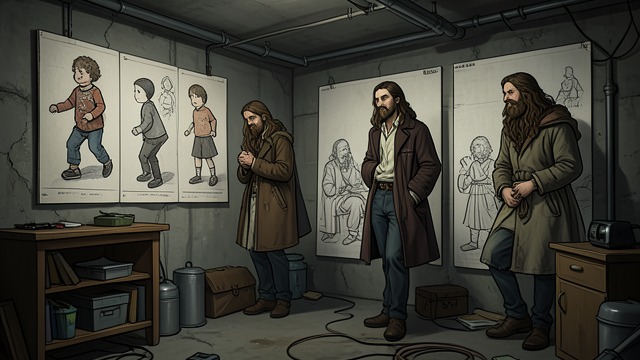
The Basement Drawings
Figures recur in variations
The narrator finds repeated images of a child and a long-haired adult in a basement setting. The figures shift across drawings while retaining a recognizable pattern.
Allegory without a key
The pictures suggest a psychological history but do not explain themselves. Their force depends on the viewer’s attempt to connect them with the family and the novel’s identities.
The School as Symbol
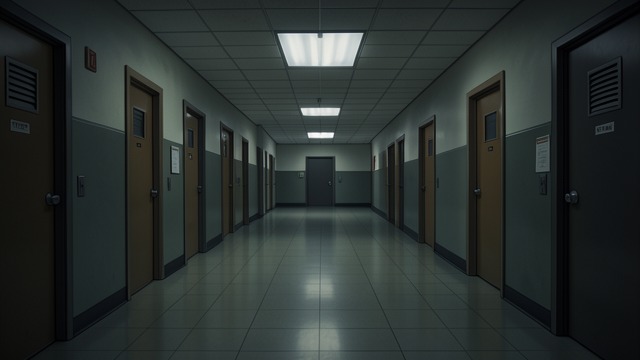
The School as Symbol
A building of futures
A high school is ordinarily associated with learning, social life, and future possibility. In the story, its empty rooms become a maze with no clear exit.
Meaning remains unstable
The school can be read as an institution, a memory, or an allegorical enclosure. The novel allows these readings to coexist without reducing the setting to one explanation.
During the teenage driving lesson
During the same driving lesson
During the drive to the farm
During the farmhouse visit
During the final ordeal
